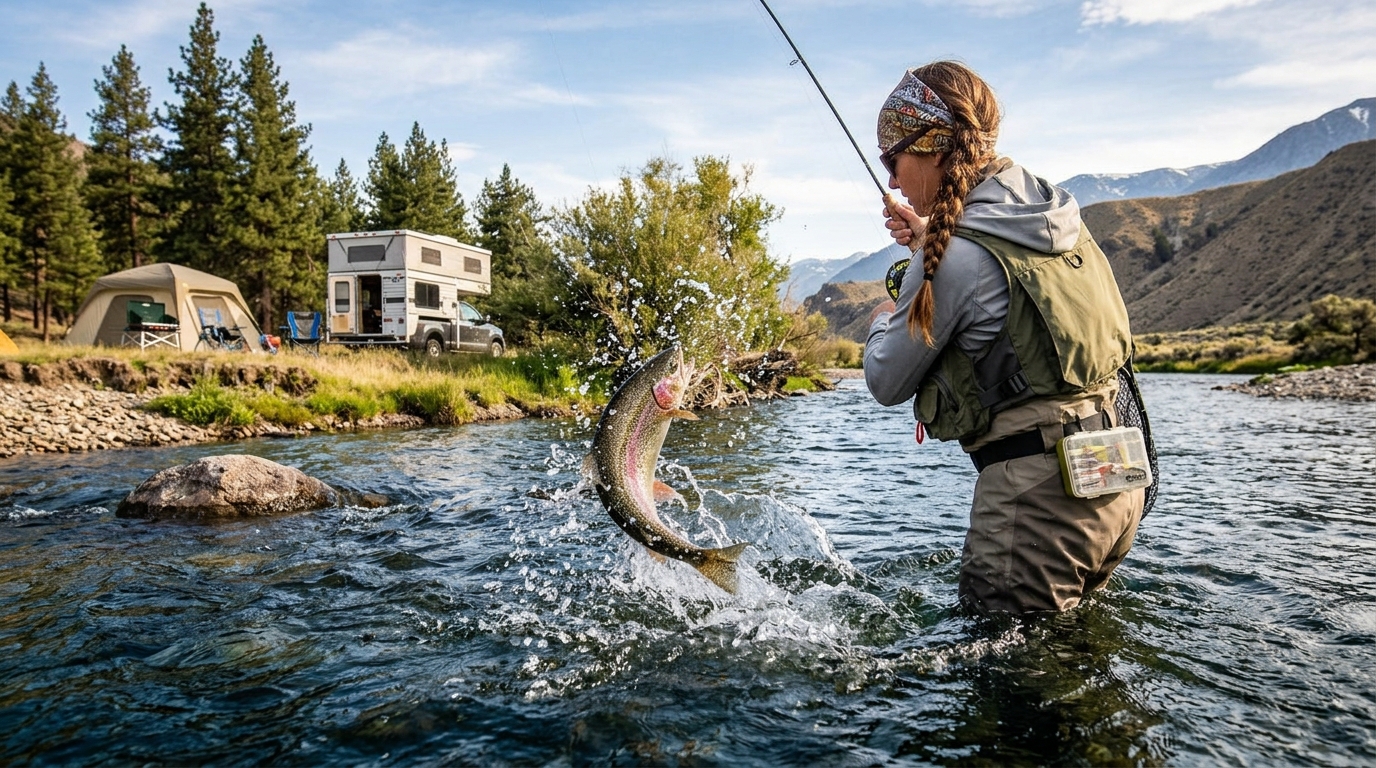
There's a kind of fishing that never makes it into the glossy travel spreads: a two-lane highway past a grain elevator and a diner with four trucks parked out front, a gravel pull-off, and a stretch of river nobody's fighting you for. That's still the everyday reality across much of the American West — Gold Medal trout streams, tailwater fisheries holding thousands of fish per mile, and desert reservoirs thick with bass, most of it running within a few miles of the same small towns where a person can still buy a parcel of raw land, drill a well, and call it home. What follows is a six-state guide to that water, moving state by state from the Rockies to the Pacific.
Colorado
Colorado's reputation as a trout state holds up to scrutiny, and most of the credit belongs to a handful of rivers that happen to run straight through the kind of towns this whole publication is built around. The Arkansas River threads Leadville, Buena Vista, and Salida for more than 150 miles, and while it isn't a river of trophy-sized fish, it's thick with rainbows and browns and forgiving enough for a float trip through Royal Gorge scenery that makes the fishing almost secondary. Southwest of there, the Animas River runs a Gold Medal stretch past Durango — the same mountain town we've written about before — with seven miles of public water and browns that grow large in the slow winter months when midges are the only game in play; caddis take over by summer. The Roaring Fork, threading Aspen, Basalt, Carbondale, and Glenwood Springs, offers two separate Gold Medal sections and a rail-trail that puts wading access within an easy walk of town. And in the northwest corner, the Yampa River near Steamboat Springs still sees relatively little pressure for a stream holding trophy rainbows — golden stonefly patterns in early season, tricos and midges once the water settles.
Wyoming
Wyoming's water is bigger, colder, and emptier than Colorado's, which is more or less the point. The North Platte does its best work in two very different stretches: Gray Reef, near Alcova outside Casper, holds an almost unreasonable 5,200 trout per mile, some pushing eight pounds, while the Miracle Mile, downstream of Pathfinder and Kortes dams, is remote tailwater nymphing with genuinely trophy fish and no crowd to speak of. Further north, the Bighorn River below Thermopolis runs trico hatches from June clear through early October, drawing dry-fly anglers who plan whole trips around it. The Green River, near La Barge and the Flaming Gorge system, regularly gives up 16-inch trout sipping dries out of fast riffles, and the Wind River, out of Shoshoni, splits neatly into freestone water above Boysen Reservoir and a tailwater fishery below it. For something quieter, the Upper North Platte near Saratoga and Medicine Bow carries an estimated 600 pounds of trout per mile through blue-winged olive and yellow sally hatches, and Sand Creek, along the Black Hills border, is a limestone-fed spring creek so clear it makes stealth part of the sport.
Montana
Montana doesn't do subtlety when it comes to trout water, and five rivers alone could fill a guidebook. The Madison, running out of Yellowstone National Park past West Yellowstone and Ennis, holds native westslope cutthroat alongside rainbows and browns in water varied enough to reward both dry-fly purists and streamer chuckers. The Big Hole River, still called Montana's Last Best River by locals, produces the state's most famous salmonfly hatch each June, with brown, rainbow, cutthroat, and even arctic grayling holding in its braided channels. Closer to Bozeman, the Gallatin — the river made famous in A River Runs Through It — carries more than 2,000 fish per mile through a canyon stretch that fishes well nearly year-round. The Missouri River tailwater below Holter Dam, near Helena and Great Falls, is almost unfair: fish counts run past 6,000 trout per mile in water so consistent it fishes well in a snowstorm. And the Yellowstone River, rolling undammed past Livingston, Big Timber, and Gardiner, is the longest free-flowing river in the Lower 48 — cutthroat water up high, brown trout water down low, and a different river every season depending on runoff.
Utah
Utah's fishing runs from high alpine creeks to red-rock desert rivers, often within the same day's drive. The Green River near Vernal is the marquee destination — a tailwater fishery below Flaming Gorge Dam holding as many as 14,000 fish per mile, reachable by float trip or on foot. The Provo River, closer to the Wasatch Front, splits into upper, middle, and lower sections running through Heber Valley and Provo Canyon, with browns, rainbows, cutthroat, and even arctic grayling rising to mayflies, caddis, and stoneflies depending on the season. Logan River, two hours north of Salt Lake in Logan Valley, turns on with salmonflies and green and gray drakes late in spring, and the Strawberry River, out toward Duchesne, cuts through red sandstone canyon country where golden eagles and the occasional black bear are as much a part of the scenery as the fish. For stillwater, Flaming Gorge itself holds lake trout up to 40 pounds alongside kokanee, browns, and burbot — though it's worth knowing the reservoir straddles the Wyoming line, and the fish don't care which state's license you're carrying.
Arizona
Arizona rewards anyone willing to look past the desert stereotype. Lees Ferry, on the Colorado River beneath thousand-foot sandstone cliffs below Glen Canyon Dam, is a genuine trophy trout fishery, cold tailwater running through some of the most dramatic canyon country in the country. Theodore Roosevelt Lake, in the central part of the state, gives up largemouth bass past ten pounds against a backdrop of saguaro-studded mountains, while Lake Havasu, out of Lake Havasu City, has more than 450 miles of shoreline and a standing reputation as one of the best bass lakes in America — largemouth, smallmouth, redear, crappie, and catfish all in play. Up in the ponderosa pine country near Williams, Kaibab Lake keeps things simple with stocked rainbows, largemouth, and channel catfish in a cool, shaded setting that feels like a different state entirely. And Patagonia Lake, about an hour south of Tucson, produces bass and catfish most of the year, with rainbow trout stocked through the winter months for anglers willing to fish in a jacket.
Oregon
Oregon's coastal range holds a version of fishing most of the country has forgotten how to do: small, brushy steelhead streams that only really turn on for a few weeks a year, and locals who plan their winters around it. The Necanicum, right at Seaside, sees a hatchery run peak in December and January followed by wild fish into late winter. The Salmon River, north of Lincoln City, runs from late summer through March, with the final two months producing the best fishing. Big Elk Creek, upstream from Toledo and Newport, and the North Fork Alsea, near the town of Alsea, both hold wild winter steelhead into February and March on modest, wadeable water. Closer to Portland, the Sandy River above the town of Sandy is a genuine four-season fishery — winter and summer steelhead, spring Chinook, fall coho — and one of the more reliable producers in a strong year, with catches climbing past 2,000 fish. None of it is glamorous water. All of it rewards someone who's willing to learn a small stretch of river instead of chasing a famous one.
Own Your Access
A piece of land near water like this isn't just scenery — it's access. Public rivers and reservoirs don't care who owns the parcel next door, but proximity still decides how often you actually get there. A well-chosen lot within reach of a Gold Medal stretch or a run of winter steelhead turns a bucket-list trip into a Saturday morning, and buys you into towns small enough that the person at the fly shop remembers your name by the second visit. It also means somewhere to park a camper, pitch a tent, or eventually build, so the season doesn't end when the drive gets too long to make twice in one weekend. That's the same logic behind everything we write about here: the value of a place is measured in more than square footage — it's measured in how much of your life you can actually spend on it.